
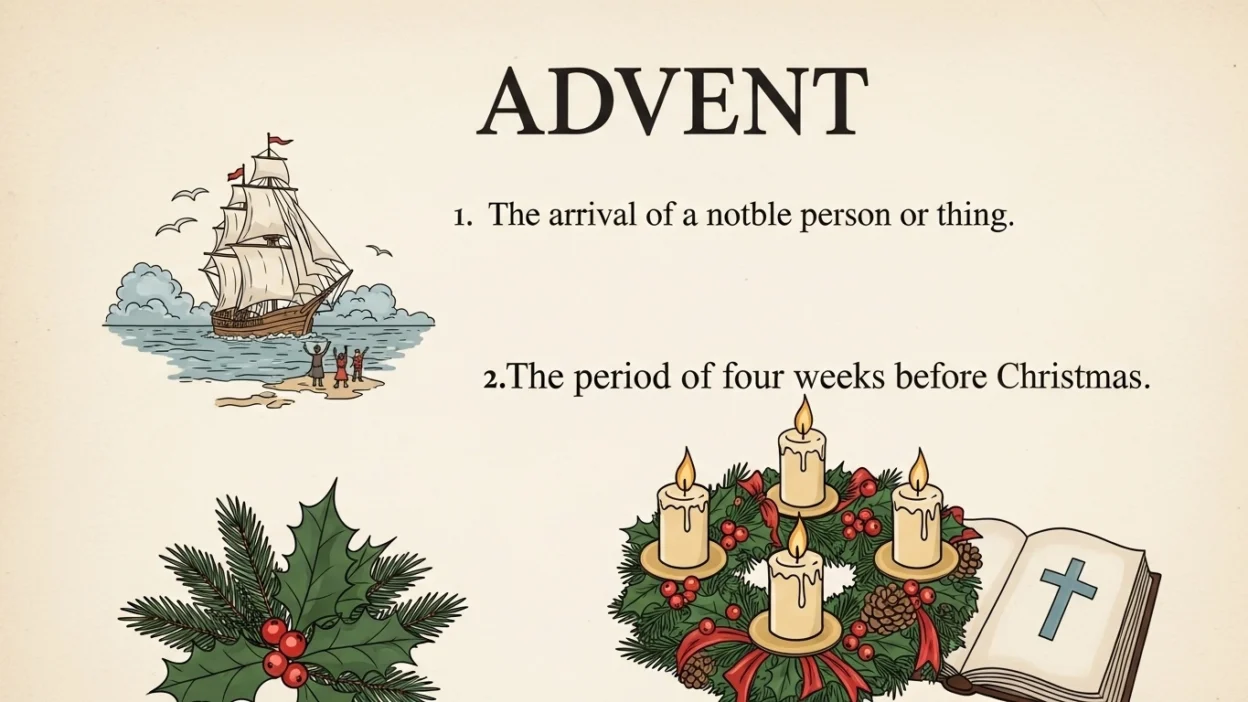
Many people search for “what does Advent mean” every year, especially as the holiday season approaches. While some associate Advent simply with Christmas calendars and decorations, its true meaning goes much deeper.
The word “Advent” comes from the Latin adventus, which means “coming” or “arrival,” and historically, it signifies a period of preparation and anticipation. In Christianity, Advent marks the time leading up to the birth of Jesus Christ, a season of reflection, prayer, and celebration.
However, Advent is not just a religious term—it has found its way into modern language and culture, often symbolizing the arrival of something significant.
Understanding Advent can clear up confusion about its timing, practices, and traditions, and give you a richer perspective on how it’s observed around the world. In this article, we will explore the definition, origin, religious significance, global traditions, and modern uses of Advent.
Advent Quick Definition
At its core, Advent means the “coming” or “arrival” of something important. The term originates from the Latin word adventus, which literally translates to “arrival” or “approach.” In everyday language, Advent can refer to the arrival of a major event, innovation, or period of significance. For example, you might hear someone say, “the advent of the internet changed the world,” using the word in a modern, figurative sense.
In a religious context, especially in Christianity, Advent has a specific meaning. It refers to the season of preparation leading up to Christmas, the celebration of the birth of Jesus Christ. Traditionally, Advent lasts for about four weeks, starting on the fourth Sunday before Christmas Day. During this time, Christians focus on reflection, prayer, and anticipation, symbolizing the spiritual preparation for Christ’s arrival.
Advent is also associated with several symbolic practices, including the Advent wreath, which features four candles representing hope, peace, joy, and love. Another familiar tradition is the Advent calendar, used to count down the days until Christmas.
While often linked directly to religious observance, the concept of Advent has expanded into modern culture, representing any awaited event or significant beginning. Whether viewed through a spiritual lens or as a metaphor for anticipation, Advent reminds us of the importance of preparation and mindful expectation.
The Origin of Advent
The word Advent has its roots in the Latin term adventus, meaning “coming” or “arrival.” This origin perfectly reflects the central theme of Advent: the anticipation of something important. Historically, the term was used in the early Christian church to describe the period of preparation for the celebration of Jesus Christ’s birth. Over time, it became a distinct season in the Christian liturgical calendar.
The early Christian church adopted Advent as a way to spiritually prepare believers for the arrival of Christ. Initially, the season was associated with fasting, reflection, and prayer. Records from as early as the 4th and 5th centuries show that Christians in regions like Gaul (modern-day France) observed periods of preparation before major religious feasts. By the Middle Ages, Advent had evolved into a four-week period leading up to Christmas, complete with specific rituals and traditions.
In addition to its religious beginnings, the concept of Advent also carried a broader cultural significance. In medieval Europe, the “advent” of kings, rulers, or major events was often marked by ceremonies and anticipation. This dual meaning—both spiritual and temporal—helped cement Advent as a term representing both literal and symbolic arrivals.
Understanding the origin of Advent gives context to its religious and cultural significance today. From its Latin roots to its formal recognition in Christian traditions, Advent has always been about preparing for the arrival of something meaningful, whether in faith, society, or personal reflection.
Advent in Christianity
In Christianity, Advent holds a deeply spiritual meaning as the season of preparation for the birth of Jesus Christ. It is observed by many Christian denominations, including Roman Catholics, Protestants, and Orthodox Christians, as a time of reflection, prayer, and anticipation. Advent typically begins on the fourth Sunday before Christmas and lasts until Christmas Eve, spanning about four weeks.
The season emphasizes spiritual readiness and hope. Christians use this time to reflect on their faith, repent for past wrongs, and focus on the coming of Christ. Theologically, Candle not only celebrates the historical birth of Jesus but also points toward His future second coming, symbolizing the ultimate arrival of salvation and peace.
Several practices and symbols are associated with Candle . The Candle wreath is one of the most recognized traditions: it features four candles, each representing hope, peace, joy, and love. Families and churches light one candle each Sunday to mark the progression of the season. The Candle calendar, often filled with small treats or messages, is another popular tradition that helps mark the countdown to Christmas.
Candle is also a time for community and charitable acts, encouraging believers to prepare their hearts and minds for Christ through kindness and service. By observing Candle , Christians embrace a period of intentional waiting, reflection, and spiritual growth, making the eventual celebration of Christmas even more meaningful.
Advent Traditions Around the World
Candle is celebrated in diverse ways across the globe, blending religious rituals with unique cultural traditions. While its core purpose remains preparing for the arrival of Christ, local customs give the season distinct flavors in different countries.
In Germany, Candle is famously marked by the Candle calendar (Adventskalender), which counts down the days to Christmas with small gifts, chocolates, or messages. Many families also use the Candle wreath with four candles, lighting one each Sunday to symbolize hope, peace, joy, and love. German towns host festive Christmas markets, creating a communal atmosphere of anticipation.
In Italy, Candle is observed through religious services and nativity scenes (presepi), which are often elaborate and displayed in homes, churches, and public spaces. Families attend special Masses and focus on preparing spiritually for Christmas Day.
In Spain, Candle includes the tradition of Las Posadas, reenacting Mary and Joseph’s search for shelter before Jesus’ birth. It is a combination of prayer, song, and community gatherings, often culminating in festive celebrations.
In North America, Candle calendars and wreaths have been popularized, with both religious and secular adaptations. Schools, churches, and families may incorporate craft activities, reflections, and daily readings to observe the season.
These global practices highlight that while the religious significance of Candle remains universal, local culture, climate, and history influence how communities celebrate and prepare during this meaningful season.
Modern Usage of Advent
While Candle originated as a strictly religious season, its meaning has expanded in modern times to include figurative and cultural uses. Today, people often use the word “Candle ” to describe the arrival of significant events, innovations, or periods of change, even outside of a religious context. For example, one might refer to “the Candle of digital technology” or “the Candle of a new era in medicine.” This broader usage highlights the core idea of anticipation and preparation that is central to Candle .
In contemporary culture, Candle continues to influence holiday traditions, marketing, and everyday language. Candle calendars have become popular worldwide, sometimes filled with chocolates, toys, or inspirational messages rather than strictly religious content. Businesses use the concept of Candle to promote seasonal products or countdowns to major events, reflecting the symbolic value of expectation and excitement.
Even literature and media adopt the term metaphorically. Authors may describe the Candle of change in a character’s life, while journalists might report on the “Candle of political or technological shifts.” These modern applications preserve the original sense of arrival and anticipation while making it relevant to daily life.
Understanding the modern usage of Candle helps bridge the gap between its religious origins and contemporary relevance. Whether in spiritual reflection, cultural tradition, or figurative language, Candle reminds us of the importance of mindful preparation, hopeful expectation, and appreciation for moments of significance in both faith and everyday life.
Advent Symbols and Significance
Candle is rich in symbols that help believers and communities reflect on the season’s spiritual meaning. These symbols serve as visual reminders of preparation, hope, and anticipation for the arrival of Christ.
One of the most recognized symbols is the Candle wreath. Traditionally, the wreath is made of evergreen branches shaped into a circle, representing eternal life and God’s unending love. It holds four candles, each representing a key virtue: hope, peace, joy, and love. Families or churches light one candle each Sunday during Advent, marking the passage of the season and encouraging reflection on each virtue. Some traditions also include a fifth candle, the Christ candle, lit on Christmas Eve to symbolize Christ’s arrival.
The Candle calendar is another widely used symbol. It counts down the days to Christmas and often contains small gifts, chocolates, or spiritual readings. Originally, it helped children understand the concept of waiting and preparation. Today, both religious and secular versions are popular worldwide.
Colors also hold significance during Candle. Purple symbolizes penance and preparation, while pink represents joy and celebration, often used on the third Sunday, known as Gaudete Sunday.
Other symbols include nativity scenes, bells, and stars, which remind participants of the birth of Jesus and the hope He brings. Together, these symbols make Candle a tangible, experiential season, allowing both children and adults to actively engage in anticipation, reflection, and celebration.
Common Misconceptions About Advent
Despite its long history and rich traditions, Advent is often misunderstood. Clearing up these misconceptions helps people appreciate its true meaning and significance.
One common myth is that Advent is the same as Christmas. While the two are closely related, Advent is actually the season leading up to Christmas, focusing on preparation and anticipation rather than the celebration itself. Advent lasts about four weeks, whereas Christmas is the celebration of Jesus’ birth.
Another misconception is that Advent is only for Christians. While it is primarily a Christian observance, the concept of anticipation and preparation can resonate more broadly. Even secular traditions, like Advent calendars filled with gifts or chocolates, reflect the theme of mindful waiting and expectation.
Many people also assume that Advent begins on the same date every year. In reality, Advent starts on the fourth Sunday before Christmas, so the date changes slightly each year, ranging from late November to early December.
Some confuse Advent with other religious or cultural traditions, such as Lent or Hanukkah, thinking all involve similar fasting or preparation rituals. However, each season has unique practices and meanings.
Lastly, some may believe that Advent is only about external rituals, like calendars or wreaths. In truth, the essence of Advent lies in spiritual reflection, hope, and readiness. Observing these practices is meant to enhance mindfulness, not replace it.
By addressing these misconceptions, we can better understand Advent as a season of reflection, anticipation, and meaningful preparation for both religious and personal growth.
FAQs:
1. What does Advent mean in simple words?
Advent means “coming” or “arrival.” In Christianity, it refers to the period of preparation and anticipation for the birth of Jesus Christ. More broadly, it can signify the arrival of something important or significant.
2. When does Advent start?
Advent begins on the fourth Sunday before Christmas and lasts approximately four weeks, ending on Christmas Eve. The exact date varies each year depending on the calendar.
3. Is Advent only for Christians?
While Advent originated as a Christian season, its themes of preparation, reflection, and anticipation can be appreciated by anyone. Secular traditions like Advent calendars have popularized it worldwide.
4. What are the main symbols of Advent?
Key symbols include the Advent wreath with four candles representing hope, peace, joy, and love, and the Advent calendar, which counts down the days to Christmas. Colors like purple and pink also hold special significance.
5. How is Advent celebrated around the world?
In Germany, Advent calendars and wreaths are popular. Italy emphasizes nativity scenes, Spain celebrates Las Posadas, and Sweden has candle-lit traditions like St. Lucia’s Day. North America combines religious and secular customs.
6. How is Advent different from Christmas?
Advent is the season of preparation, while Christmas celebrates the birth of Jesus. Observing Advent enhances the spiritual and cultural experience of the holiday season.
Conclusion:
In summary, Advent is much more than just a countdown to Christmas. Rooted in the Latin word adventus, meaning “coming” or “arrival,” it represents a season of preparation, reflection, and anticipation.
In Christianity, Advent is a time to spiritually ready oneself for the birth of Jesus Christ, marked by traditions such as the Advent wreath, Advent calendar, and symbolic colors.
Around the world, different cultures celebrate Advent in unique ways, from Germany’s festive calendars to Spain’s Las Posadas and Sweden’s candle-lit St. Lucia celebrations.
Beyond religious observance, the term Advent has also entered modern language, symbolizing the arrival of significant events, changes, or innovations.
If observed spiritually, culturally, or figuratively, Advent reminds us of the importance of mindful preparation and hopeful expectation.
By understanding its origin, practices, and symbolism, we can fully appreciate Advent as a meaningful and enriching season in both faith and everyday life.
Discover More Articles
- What Does SEO Stand For Explained Simply for 2026
- What Does CDC Stand For: A Complete Guide for Everyone 2026
- What Does Al Dente Mean for Perfect Pasta Every Time 2026

I’m the author of Jokesattack.com, where humor meets creativity! Bringing you nonstop laughter with the best jokes, memes, and funny moments every day.