If you’ve ever wondered what ChatGPT stands for, you’re not alone. With the rapid rise of AI-powered tools, many people are curious about this popular chatbot and its capabilities.
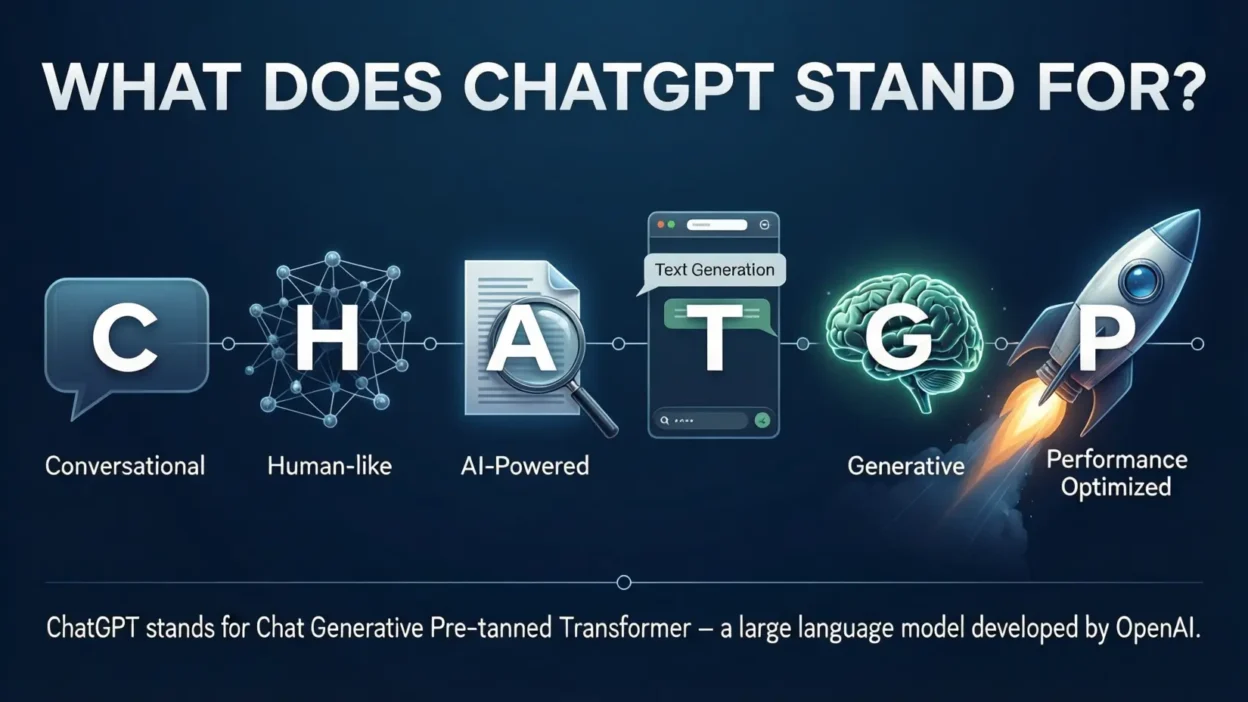
ChatGPT stands for Chat Generative Pre-trained Transformer, an AI model that generates human-like text and engages users in interactive conversations.
ChatGPT isn’t just a name it’s an acronym that explains exactly what this AI can do. Understanding its full form helps clarify how it works and why it’s becoming an essential tool for writers, students, developers, and businesses alike. In simple terms, ChatGPT stands for Chat Generative Pre-trained Transformer, a model designed to understand and generate human like text.
People often search for this keyword because they want to know the difference between ChatGPT and other AI tools, how it produces content, and why it’s called that way.
In this article, we’ll break down the meaning, origin, and practical uses of ChatGPT, helping you fully understand this revolutionary AI technology.
What Does ChatGPT Stand For Quick Answer
The term ChatGPT stands for Chat Generative Pre-trained Transformer, and each word in this acronym gives insight into how this AI model functions.
- Chat – This highlights its core ability: engaging in natural, human-like conversations. ChatGPT is designed to respond to questions, hold discussions, and assist users in a conversational format. Whether you’re asking for a recipe, coding help, or writing advice, the “Chat” part reflects its interactive nature.
- Generative – ChatGPT doesn’t just select from pre-written responses. It generates text dynamically based on your input. This allows it to create unique answers, stories, summaries, and more, making it a versatile tool for content creation, brainstorming, and learning.
- ChatGPT can be understood as an abbreviation and acronym for Chat Generative Pre-trained Transformer. This name explains its capabilities: it engages in conversational chat, generates original text, is pre-trained on extensive datasets, and uses a transformer neural network to provide coherent, context-aware responses. Whether users search for the acronym, abbreviation, or meaning, this explanation answers all queries clearly.
- What Does ChatGPT Stand For Acronym The acronym ChatGPT breaks down as Chat Generative Pre-trained Transformer, explaining its ability to chat, create original text, use pre-trained knowledge, and operate via transformer neural networks.
- Pre-trained – Before you even interact with it, ChatGPT has been trained on massive datasets containing books, articles, websites, and other sources. This pre-training equips it with a broad understanding of language, context, and knowledge, which it fine-tunes when responding to users.
- Transformer – This refers to the type of neural network architecture that powers ChatGPT. Transformers are designed to handle large amounts of data efficiently and understand context, enabling the AI to produce coherent, context-aware responses.
For example,
when you ask ChatGPT to write an essay, it uses its pre-trained knowledge and generative ability to craft a response that reads naturally, just like a human wrote it.
ChatGPT Meaning What Does ChatGPT Stand For
The meaning of ChatGPT is Chat Generative Pre-trained Transformer, a tool designed to generate human-like text, assist in conversations, and support tasks across writing, coding, and learning.
What Does ChatGPT Stand For Abbreviation
As an abbreviation, ChatGPT represents Chat Generative Pre-trained Transformer. Each part reflects its functionality: “Chat” for conversations, “Generative” for text creation, “Pre-trained” for prior learning, and “Transformer” for its neural network architecture.
The Origin of ChatGPT
Understanding the origin of ChatGPT gives insight into how it became one of the most widely used AI tools today. ChatGPT was developed by OpenAI, a leading artificial intelligence research lab founded in 2015 with the mission to ensure AI benefits all of humanity. The foundation for ChatGPT lies in the GPT (Generative Pre-trained Transformer) model series, which started with GPT in 2018. GPT-2 followed in 2019, offering more advanced language generation capabilities, and GPT-3 in 2020 further improved the model’s fluency and understanding.
The name “ChatGPT” was introduced when OpenAI released a chatbot version of GPT-3 in November 2022. It combined the GPT architecture with a focus on conversational AI, making it easy for users to interact naturally with the model. Essentially, it was a practical application of GPT’s generative language skills in a chat-friendly format.
The term itself is deliberate: “Chat” highlights its interactive nature, “Generative” emphasizes its ability to create new content, “Pre-trained” signals the extensive training on large datasets, and “Transformer” points to the advanced neural network powering it.
Over time, ChatGPT evolved with improvements in accuracy, contextual understanding, and user accessibility. Today, it’s not only a tool for casual conversations but also widely used in education, business, content creation, and coding assistance. Its origin shows a careful evolution from a research model to a practical AI assistant that millions rely on daily.
How ChatGPT Works
ChatGPT works by combining advanced AI technology with vast amounts of language data to generate human-like text. At its core, it uses a transformer neural network, which is a type of deep learning model designed to understand context, relationships between words, and patterns in language. This architecture allows ChatGPT to produce coherent and context-aware responses.
In AI terms, ChatGPT stands for Chat Generative Pre-trained Transformer, which is an advanced AI language model. It combines conversational ability with generative text creation, pre-trained knowledge, and transformer-based neural networks. This makes it capable of understanding context, producing coherent responses, and assisting with tasks like content creation, coding, and problem-solving.
The process begins with pre-training, where the AI learns from a massive dataset that includes books, articles, websites, and more. During this stage, it absorbs grammar, vocabulary, facts, and general knowledge, forming the foundation for understanding and generating language. After pre-training, ChatGPT undergoes fine-tuning, where it is adjusted with specific instructions and conversational examples. This makes it more accurate and user-friendly for real-world interactions.
When a user inputs a question or prompt, ChatGPT analyzes the context and predicts the most likely words or sentences that should come next. It doesn’t “think” like a human; instead, it calculates probabilities based on patterns learned during training. This is why it can answer a wide variety of questions, write essays, summarize text, generate code, and even create creative content like stories or poems.
Despite its capabilities, ChatGPT has limitations. It may produce incorrect information, misunderstand ambiguous queries, or reflect biases present in the training data. Still, its ability to generate fast, coherent, and context-aware responses makes it one of the most advanced AI language models available today, bridging the gap between humans and artificial intelligence.
What Does ChatGPT Stand For in AI
ChatGPT in AI stands for Chat Generative Pre-trained Transformer. It is an advanced language model designed to understand context, generate human-like text, and assist with tasks like content creation, coding, and problem-solving. Its AI architecture, based on the transformer model, allows it to analyze language patterns efficiently and provide coherent, context-aware responses.
Practical Uses of ChatGPT
ChatGPT is more than just a chatbot; its applications span across personal, educational, and professional domains. One of the most popular uses is content creation. Writers, bloggers, and social media managers use ChatGPT to draft articles, create captions, generate ideas, and even write entire scripts. Its ability to produce coherent, human-like text makes content development faster and more efficient.
In the world of coding and software development, ChatGPT is a powerful assistant. Developers use it to generate code snippets, debug programs, explain complex functions, and learn new programming languages. By providing step-by-step guidance, ChatGPT can reduce time spent on problem-solving and learning.
Education and learning are other areas where ChatGPT shines. Students can ask questions, get explanations of difficult concepts, or summarize lengthy material. Teachers and tutors can use it to create exercises, lesson plans, and practice quizzes. Its conversational style makes learning interactive and personalized.
Businesses also leverage ChatGPT for customer support. AI chatbots powered by ChatGPT can handle common inquiries, provide product recommendations, and offer 24/7 assistance, improving efficiency and customer satisfaction.
Additionally, ChatGPT supports creative projects, including storytelling, poetry, and brainstorming for marketing campaigns. Its ability to generate ideas quickly allows professionals and hobbyists alike to experiment with concepts and drafts.
Overall, ChatGPT’s versatility across content creation, coding, education, business, and creativity demonstrates why it has become an indispensable tool for millions of users worldwide, transforming how we work, learn, and interact with technology.
What Does ChatGPT Stand for in Chat?
ChatGPT stands for Chat Generative Pre-trained Transformer. The name may sound technical, but each part explains how the system works and why it is so powerful in chat-based interactions. It is designed to understand human language and generate meaningful, conversational responses in real time. By combining advanced language processing with conversational abilities, ChatGPT has become one of the most recognized AI tools in modern communication.
The word “Chat” refers to the system’s primary function—engaging in conversation. Unlike traditional software that requires specific commands, ChatGPT is built to interact naturally with users. It can answer questions, provide explanations, and hold discussions in a way that feels similar to human dialogue. This conversational ability makes it useful for customer support, learning, and everyday communication.
The term “Generative” means that the model can create new content rather than simply retrieving stored information. It generates responses based on patterns it has learned during training. Whether writing an article, explaining a concept, or drafting an email, ChatGPT produces original text tailored to the user’s input.
“Pre-trained” indicates that the model has already been trained on a vast amount of text data before being released to users. This training allows it to understand grammar, context, and various topics. Because it is pre-trained, users can immediately start interacting with it without needing to teach it basic language skills.
Finally, “Transformer” refers to the type of artificial intelligence architecture used to build the system. The transformer model helps ChatGPT understand context, relationships between words, and long conversations more effectively than earlier AI systems. This technology enables it to provide accurate, coherent, and context-aware responses.
Overall, ChatGPT stands for Chat Generative Pre-trained Transformer, a name that reflects its ability to generate intelligent, conversational responses. Its structure and advanced technology explain why it has become such a powerful tool for communication, learning, and digital interaction.
What Does ChatGPT Stand for in Memes?
In meme culture, ChatGPT is often joked about humorously, but its official meaning remains Chat Generative Pre-trained Transformer. Memes play on its conversational AI abilities, generative text creation, and the surprising ways it can produce witty, human-like responses. While it’s a fun reference online, the acronym reflects a serious AI technology designed for text generation and interactive dialogue.
What Does Chat GPT Stand for in Spanish
ChatGPT is a widely recognized artificial intelligence tool, but many Spanish speakers often wonder what its name actually means in their language. Understanding the meaning behind the acronym helps clarify how the technology works and why it has become so popular. The name ChatGPT may sound technical, yet its meaning is quite simple when broken down and translated into Spanish.
The word “Chat” in Spanish is commonly translated as “chat” or “conversación.” While “chat” is widely used in Spanish-speaking countries as a borrowed English term, “conversación” better explains its function. It refers to the interactive dialogue between the user and the AI system. This highlights the conversational nature of the tool, which is designed to respond naturally and fluidly to questions and prompts.
The acronym “GPT” stands for “Generative Pre-trained Transformer.” In Spanish, this is translated as “Transformador Generativo Preentrenado.” “Generativo” means it can create or produce text. “Preentrenado” indicates that the model was trained beforehand using large amounts of data. “Transformador” refers to the specific type of neural network architecture that processes and understands language patterns efficiently.
In simple terms, when translated fully into Spanish, ChatGPT can be understood as a “Chat basado en un Transformador Generativo Preentrenado.” This describes an AI system capable of generating human-like text through advanced language modeling techniques. The name itself reflects both its conversational ability and its underlying machine learning technology.
Overall, understanding what ChatGPT stands for in Spanish makes the concept less intimidating and more accessible. By breaking down the acronym into “Chat” and “Transformador Generativo Preentrenado,” Spanish speakers can better appreciate how this powerful AI tool works and why it plays such an important role in modern communication and digital interaction.
What Does ChatGPT Stand for in French?
ChatGPT is a widely recognized artificial intelligence tool, but many French-speaking users often wonder what its name actually means in their language. Understanding what ChatGPT stands for in French helps clarify both its purpose and its technological foundation. While the name itself remains the same globally, its expanded form can be translated and explained in French to better reflect its meaning and functionality.
ChatGPT stands for “Chat Generative Pre-trained Transformer” in English. In French, this can be translated as “Transformateur Génératif Pré-entraîné pour le Dialogue.” The word Chat refers to conversation or dialogue, highlighting the system’s ability to interact with users. Génératif means generative, indicating that the model can create text rather than simply selecting predefined responses. Pré-entraîné explains that the system has been trained in advance on large amounts of data. Finally, Transformateur refers to the type of neural network architecture used to power the model.
The term Transformateur is especially important in understanding the technology behind ChatGPT. In artificial intelligence, a transformer is a deep learning model designed to process and understand language patterns efficiently. This architecture allows ChatGPT to analyze context, predict words, and generate coherent responses in multiple languages, including French.
For French-speaking students and professionals, knowing the translated meaning makes the concept more accessible. It helps bridge the gap between technical English terminology and French understanding. Whether used for education, business, or creative writing, the explanation of its name provides insight into how the system works.
Overall, in French, ChatGPT can be understood as a “Transformateur Génératif Pré-entraîné pour le Dialogue.” This translation reflects its core function: an advanced AI system designed to generate human-like conversations through pre-trained transformer technology, making it a powerful communication tool worldwide.
What Does ChatGPT Stand for in Texting?
In texting and online conversations, many people come across the term “ChatGPT” and wonder what it actually stands for. ChatGPT is not a casual slang word or abbreviation created for texting; instead, it is the name of an advanced artificial intelligence tool. The term stands for “Chat Generative Pre-trained Transformer.” While it may sound technical, understanding its meaning helps clarify why it has become so popular in digital communication and messaging platforms.
In texting, ChatGPT stands for Chat Generative Pre-trained Transformer. It is not slang but an AI system built for conversation. “Chat” refers to its messaging ability, “Generative” highlights content creation, “Pre-trained” shows prior learning from large datasets, and “Transformer” refers to the AI architecture enabling context-aware responses. This explains why ChatGPT is widely used in messaging platforms for fast, intelligent replies.
In texting, ChatGPT stands for Chat Generative Pre-trained Transformer. It is not slang; it is an AI system that generates context-aware, human-like replies in messages, making conversations faster and more intelligent.
“Pre-trained” means the system was trained on large amounts of text data before being made available to users. Through this training process, it learned language patterns, grammar, context, and general knowledge. When people use ChatGPT in texting, they are interacting with a system that has already learned how human language typically works.
Finally, “Transformer” refers to the type of machine learning architecture used to build the model. A transformer helps the system understand context and relationships between words in a sentence. This is why ChatGPT can provide relevant and coherent responses during text-based conversations.
Overall, when someone asks what ChatGPT stands for in texting, the answer is “Chat Generative Pre-trained Transformer.” It is not slang but the name of an AI system built for conversation. Understanding the full meaning behind the name helps explain why it has become such a powerful and widely used tool in modern digital communication.
ChatGPT vs Other AI Tools
With the rise of AI technology, many users wonder how ChatGPT compares to other AI tools. While ChatGPT is a conversational AI powered by the GPT architecture, there are other popular models, such as Google Bard, Claude, and LLaMA, each with its own strengths and limitations.
One of ChatGPT’s biggest advantages is its conversational fluency. It can maintain context over multiple exchanges, making it ideal for extended conversations or complex instructions. Its pre-training on vast datasets allows it to answer a wide variety of questions and produce coherent, human-like responses. This makes ChatGPT particularly strong for content creation, tutoring, and brainstorming.
By contrast, tools like Bard are integrated closely with Google Search, providing more real-time information and facts, which can make them better for queries requiring up-to-date data. Claude, developed by Anthropic, focuses on ethical AI use and minimizing biases, making it appealing for sensitive applications. LLaMA, from Meta, emphasizes research accessibility, allowing developers and academics to explore AI modeling more freely.
While each AI has unique features, ChatGPT is often preferred for its versatility and ease of use. It doesn’t require technical expertise, and its ability to generate creative outputs sets it apart from more factual or research-focused tools.
In summary, ChatGPT excels in conversational and generative tasks, while other AI models may outperform it in real-time information retrieval or specialized ethical research. Choosing the right AI depends on the user’s goals, but ChatGPT remains a leading option for most everyday applications.
Common Misconceptions About ChatGPT
Despite its growing popularity, ChatGPT is often misunderstood. Many users have misconceptions about its abilities, which can lead to unrealistic expectations. Understanding these myths helps users interact with ChatGPT more effectively.
One common misconception is that ChatGPT can think or feel like a human. In reality, ChatGPT does not have consciousness, emotions, or personal experiences. It generates responses based on patterns learned from data, not personal understanding. Its answers may appear intelligent, but it does not “understand” in the human sense.
Another widespread belief is that ChatGPT always provides correct information. While it can give accurate and helpful answers, it can also produce errors, outdated information, or misleading responses. Users should verify important facts rather than relying solely on the AI.
Some people assume ChatGPT can replace human jobs entirely. While it can assist with writing, coding, or customer support, it is a tool designed to augment human work, not fully replace it. Human judgment and creativity remain essential.
There’s also confusion between GPT, ChatGPT, and AI in general. GPT refers to the underlying model, ChatGPT is the chatbot application of GPT, and AI is the broad field encompassing all intelligent machines.
Lastly, some users worry about privacy or data security. While OpenAI takes measures to protect user data, sensitive information should always be handled carefully.
Limitations and Ethical Considerations
While ChatGPT is a powerful AI tool, it has several limitations and raises important ethical considerations that users should be aware of. Understanding these aspects is essential for responsible usage.
One limitation is accuracy. ChatGPT can generate convincing answers, but it may provide incorrect, outdated, or incomplete information. Users must fact-check critical content, especially for education, research, or professional work. Additionally, ChatGPT does not have real-time knowledge of current events beyond its training data, which can limit its usefulness for time-sensitive information.
Bias is another concern. Since ChatGPT is trained on large datasets from the internet, it may reflect societal biases present in the data. OpenAI works to reduce these biases, but some may still appear in its responses. Users should be aware and approach outputs critically.
Ethical considerations also include privacy and data security. While interactions are generally protected, sharing sensitive personal information should be avoided. Responsible usage involves not relying on ChatGPT for decisions involving personal, financial, or legal consequences without human oversight.
Moreover, over-reliance on AI for creative or professional tasks can reduce human critical thinking and originality. ChatGPT should be viewed as a tool to assist and enhance human work, not replace it.
By understanding these limitations and ethical concerns, users can make better-informed decisions, ensuring ChatGPT is used safely, responsibly, and effectively, maximizing its benefits while minimizing potential risks.
FAQs:
1. What does GPT stand for?
GPT stands for Generative Pre-trained Transformer. It is the underlying AI model that enables ChatGPT to understand and generate human-like text.
The “GPT” in ChatGPT stands for Generative Pre-trained Transformer. This is the core AI model behind the chatbot. Generative means it can create text, Pre-trained shows it learned from massive datasets, and Transformer refers to the neural network architecture that allows ChatGPT to understand context, relationships between words, and generate coherent, human-like responses.
2. What Does ChatGPT Stand For GPT Meaning?
The “GPT” in ChatGPT stands for Generative Pre-trained Transformer, the AI model that powers ChatGPT. “Generative” means it creates text, “Pre-trained” shows prior learning, and “Transformer” refers to its neural network structure enabling context-aware responses.
3. Who created ChatGPT?
ChatGPT was developed by OpenAI, an AI research organization founded in 2015. OpenAI focuses on creating safe and useful artificial intelligence technologies.
4. Is ChatGPT free to use?
Yes, ChatGPT has a free version available online. However, OpenAI also offers a premium subscription, called ChatGPT Plus, which provides faster responses, priority access, and enhanced features.
5. Can ChatGPT replace human jobs?
Not entirely. While ChatGPT can assist with tasks such as writing, coding, and customer support, it cannot fully replace human judgment, creativity, or decision-making. It is designed to augment human work.
6. How secure is ChatGPT with personal data?
OpenAI takes measures to protect user data, but users should avoid sharing sensitive information, as AI systems store interactions for model improvement and monitoring purposes.
7. How accurate is ChatGPT?
ChatGPT can provide useful and coherent responses, but it may produce errors or outdated information. Fact-checking is recommended for critical tasks.
8. Can ChatGPT learn from me personally?
ChatGPT does not have memory of past conversations in the free version. It generates responses based on patterns in data, not individual users’ behavior.
Conclusion:
In summary, understanding what ChatGPT stands for is the first step toward appreciating the power and versatility of this AI tool.
ChatGPT, which stands for Chat Generative Pre-trained Transformer, combines advanced AI technology with conversational design to generate human-like text, answer questions, and assist users across a wide range of tasks.
Its name reflects its purpose: a chatbot capable of generating intelligent responses using pre-trained knowledge powered by transformer neural networks.
The origin of ChatGPT highlights its evolution from the GPT model series developed by OpenAI, demonstrating a careful progression from research-focused AI to a practical, user-friendly tool.
Over time, it has become indispensable in areas like content creation, coding, education, business, and creative projects. Its applications continue to expand as AI becomes more integrated into daily life and professional workflows.
While ChatGPT is powerful, it is not without limitations. Users must be mindful of its potential errors, biases, and ethical considerations, such as privacy and over-reliance on AI for decision-making.
Discover More Articale
- What Does TW Mean? Ultimate Guide for 2026
- What Does ACH Stand for in Banking for 2026
- What Does Share Focus Status mean for 2026

I’m the author behind Jokesattack.com, where I share the funniest jokes, puns, and memes to make your day brighter with laughter. 😄🎉