
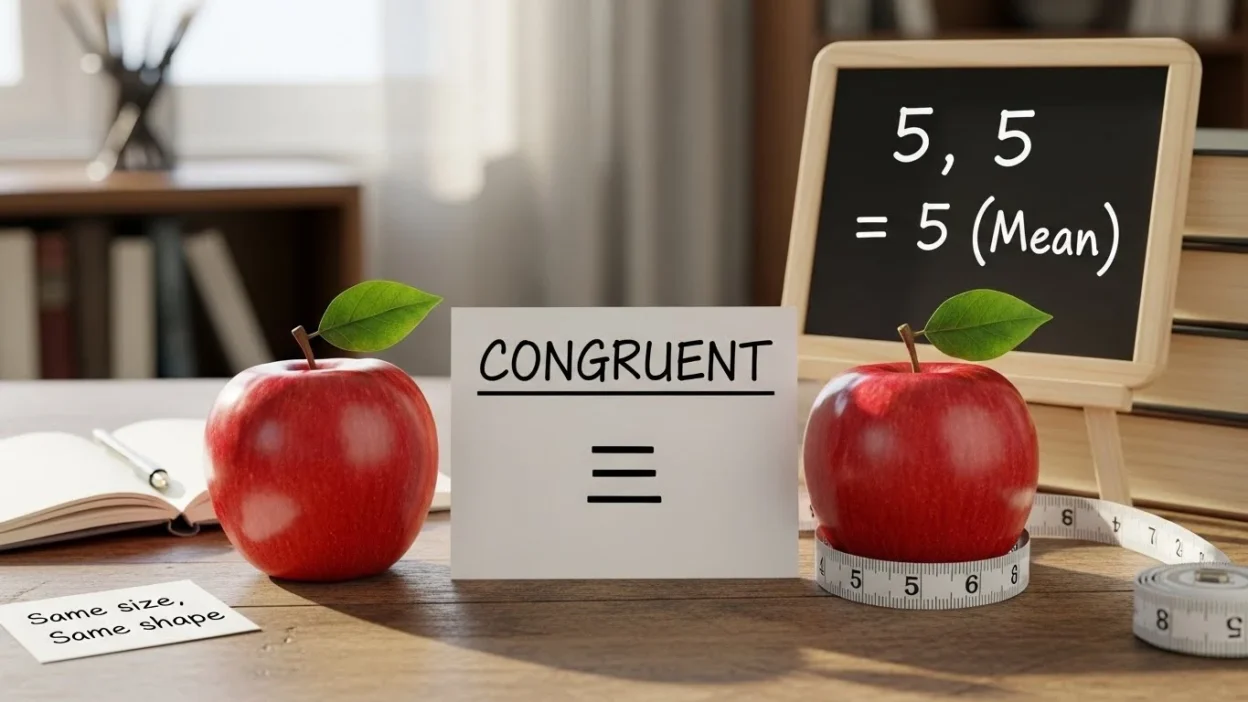
Mathematics is full of terms that can sometimes be confusing, and one of them is congruent.
Many students hear the word and wonder, “Does it just mean equal?” While the idea is similar, congruence in math has a very specific meaning: it refers to shapes or figures that have the same size and shape.
Understanding congruence is essential, especially in geometry, where it helps in identifying matching triangles, angles, and other figures.
If you’re solving problems about triangles, quadrilaterals, or even simple line segments, knowing what congruent means makes it easier to follow geometric proofs and exercises.
In this article, we will break down the meaning of congruent in math, explain the congruence symbol (≅), show clear examples, highlight real-life applications, and clear up common mistakes so you can confidently recognize congruent figures in any mathematical problem.
Congruent in Math Quick Definition
In mathematics, the term congruent is used to describe figures or objects that have the same shape and size. Unlike equality, which compares numerical values, congruence compares the dimensions and form of shapes. For example, two triangles with identical side lengths and angles are considered congruent, even if they are positioned differently on the page.
The symbol for congruence is ≅, and it is commonly used in geometry to show that two shapes are congruent. For instance, if triangle ABC has sides and angles exactly matching triangle DEF, we write it as ΔABC ≅ ΔDEF. Similarly, two line segments of the same length, say AB and CD, are written as AB ≅ CD, and two angles with the same measure, like ∠XYZ and ∠PQR, are written as ∠XYZ ≅ ∠PQR.
Congruence is not limited to triangles; it applies to all geometric figures, including quadrilaterals, polygons, and circles. Two shapes are congruent if one can be transformed into the other through rotation, reflection, or translation without changing its size or shape.
Understanding congruence is a foundation for solving geometric problems, proving theorems, and identifying symmetry in real-life objects. By recognizing congruent figures, students can simplify complex problems and gain confidence in their geometric reasoning.
Congruent Meaning in Mathematics
Congruent in mathematics refers to figures or objects that have the same shape and the same size. When two shapes are congruent, they match each other exactly when placed on top of one another. This concept is widely used in geometry and plays an important role in understanding shapes, angles, and measurements. The idea of congruence helps students compare figures accurately and solve geometric problems with confidence.
In geometry, congruent shapes are most commonly discussed in the context of triangles. Two triangles are considered congruent if their corresponding sides and angles are equal. Mathematicians use specific rules such as Side-Side-Side (SSS), Side-Angle-Side (SAS), and Angle-Side-Angle (ASA) to determine triangle congruence. These rules provide clear methods for proving that two triangles are exactly the same in size and shape.
Congruence is not limited to triangles. Other shapes, including squares, rectangles, and circles, can also be congruent if all their corresponding measurements are equal. For example, two circles with the same radius are congruent. Similarly, two rectangles with equal length and width are congruent. This principle ensures precision when comparing geometric figures.
The concept of congruence is also important in coordinate geometry. Shapes plotted on a graph can be proven congruent through transformations such as translation, rotation, and reflection. If one figure can be moved or flipped to perfectly overlap another without resizing, the figures are congruent. This helps students understand symmetry and spatial reasoning.
Beyond the classroom, congruence has practical applications in engineering, architecture, and design. Professionals rely on congruent measurements to ensure accuracy and structural stability. Overall, understanding the meaning of congruent in mathematics builds a strong foundation in geometry and enhances logical thinking skills.
The Symbol for Congruent (≅)
In mathematics, the congruence symbol (≅) is used to indicate that two shapes, angles, or line segments are congruent — that is, they have the same size and shape. This symbol is essential because it allows mathematicians and students to quickly show similarity without writing lengthy descriptions.
For example, if two triangles, ΔABC and ΔDEF, have exactly the same side lengths and angles, we write: ΔABC ≅ ΔDEF. This tells us immediately that all corresponding sides and angles of these triangles are equal. Similarly, if two line segments AB and CD are equal in length, we can write AB ≅ CD. For angles, ∠XYZ ≅ ∠PQR indicates that both angles have the same measure.
It is important to note that congruence is different from equality. Equality (=) is used for numbers or quantities, like 5 + 3 = 8, while congruence (≅) compares the geometric properties of figures. Two triangles may look different in position or orientation but still be congruent if their side lengths and angles match perfectly.
The congruence symbol is often used alongside geometric proofs and theorems. For instance, when proving that two triangles are congruent, you may reference rules like SSS (Side-Side-Side), SAS (Side-Angle-Side), or ASA (Angle-Side-Angle). Understanding this symbol and using it correctly is crucial for geometry students, as it communicates precise information about figures in a concise way.
Congruent Meaning in Math Angles
Congruent angles are a fundamental concept in geometry that help students understand equality in shapes and measurements. In mathematics, the term “congruent” means exactly equal in size and shape. When we talk about congruent angles, we are referring to two or more angles that have the same measure, regardless of their position or orientation. This concept plays a key role in solving geometric problems and understanding relationships between lines and shapes.
In geometry, congruent angles are identified by having the same degree measurement. For example, if one angle measures 60 degrees and another angle also measures 60 degrees, they are considered congruent. It does not matter if one angle is flipped, rotated, or placed in a different part of a diagram. As long as their measurements are equal, they remain congruent.
Congruent angles are often marked in diagrams using matching arc symbols. These small curved lines inside the angles indicate that the marked angles have equal measurements. This visual representation helps students quickly recognize angle relationships when solving problems involving triangles, parallel lines, and polygons.
One common place where congruent angles appear is in triangles. For example, in an isosceles triangle, the base angles are always congruent. Similarly, when two parallel lines are cut by a transversal, alternate interior angles and corresponding angles are congruent. Understanding these relationships makes it easier to prove geometric theorems and solve equations involving angle measures.
Congruent angles are also important in real-world applications such as construction, engineering, and design. Accurate angle measurement ensures that structures are balanced and symmetrical. By understanding the meaning of congruent angles, students build a strong foundation for more advanced topics in geometry and mathematics.
Overall, congruent angles refer to angles that have exactly the same degree measurement. Their importance in geometry, problem-solving, and practical applications highlights why this concept is essential for anyone learning mathematics.
Congruent Shapes in Geometry
Congruence is most commonly used in geometry to compare shapes and figures. A shape is congruent to another if it has the same size and shape, even if it is rotated, reflected, or moved. Understanding congruent shapes helps students solve problems, prove theorems, and identify patterns in geometry.
Triangles are the most frequent example. Two triangles are congruent if their corresponding sides and angles match. There are several rules to check triangle congruence:
- SSS (Side-Side-Side): All three sides of one triangle are equal to the three sides of another.
- SAS (Side-Angle-Side): Two sides and the included angle of one triangle match another triangle.
- ASA (Angle-Side-Angle): Two angles and the included side of one triangle match another.
- AAS (Angle-Angle-Side): Two angles and a non-included side are equal.
- RHS (Right angle-Hypotenuse-Side): Used for right-angled triangles with equal hypotenuse and one side.
Quadrilaterals and other polygons can also be congruent. For example, two squares or rectangles are congruent if their corresponding sides and angles are identical.
Circles are congruent if their radii are equal, regardless of their position on a plane.
To summarize, congruent shapes in geometry are identical in size and shape, and one shape can be mapped onto the other through rotation, reflection, or translation. Recognizing congruent shapes is vital for solving geometric problems and visualizing symmetry in both academic and real-world contexts, such as architecture and design.
Examples of Congruent in Math
Example 1: Triangles
Suppose we have triangle ΔABC with sides 3 cm, 4 cm, and 5 cm, and another triangle ΔDEF with the same side lengths. Since all corresponding sides are equal, we can write: ΔABC ≅ ΔDEF. Even if one triangle is rotated or flipped, they are still congruent because the size and shape remain unchanged.
Example 2: Line Segments
Two line segments, AB = 7 cm and CD = 7 cm, are congruent. Using the congruence symbol, we write: AB ≅ CD.
Example 3: Angles
Angles are also compared using congruence. If ∠XYZ = 60° and ∠PQR = 60°, then: ∠XYZ ≅ ∠PQR.
Example 4: Quadrilaterals
Two rectangles measuring 6 cm × 4 cm are congruent because all sides and angles match.
Example 5: Real-Life Scenario
Think about two identical puzzle pieces. Even if one is rotated or turned upside down, they fit perfectly in the same spot. This illustrates congruence in a practical way.
How Congruent Differs from Equal
One of the most common misunderstandings in mathematics is confusing congruent with equal. While they may seem similar, they describe different concepts.
Equality (=) is used for numbers or values. For example, 5 + 3 = 8 shows that two quantities are the same. Equality does not involve shapes, angles, or sizes; it only compares numerical values.
Congruence (≅), on the other hand, refers to geometric objects. Two shapes are congruent if they have the same size and shape, regardless of their orientation or position. For instance, two triangles with identical side lengths and angles are congruent, even if one is rotated, flipped, or moved to another location.
Example of the difference:
- Two numbers: 7 = 7 (equality)
- Two triangles: ΔABC ≅ ΔDEF (congruence)
Another important point is that equal shapes are not necessarily congruent. For example, two rectangles may have the same area, but if their side lengths differ, they are not congruent. Conversely, congruent shapes always have equal areas, but their equality is based on size and shape, not just area.
Understanding this distinction is crucial for geometry. It ensures that students use the correct symbol (≅) when comparing figures and avoid mistakes in proofs, exercises, and real-life applications. Remember, congruence is about shape and size, while equality is about numerical value.
Real Life Applications of Congruence
Congruence is not just a concept in textbooks—it is used in many real-life situations where precision and matching are important. Understanding congruence helps us recognize patterns, design objects, and solve practical problems.
1. Architecture and Construction:
Builders often use congruent shapes when designing structures. For example, identical windows, doors, or tiles must be congruent to ensure symmetry and proper fitting. Using congruent triangles in trusses and supports helps maintain stability in roofs and bridges.
2. Art and Design:
Artists and designers frequently use congruence to create symmetry and balance. For instance, a repeated pattern in a mosaic or a decorative border often uses congruent geometric shapes. Fashion designers may use congruent pieces of fabric to create perfectly matched clothing parts.
3. Carpentry and Engineering:
Carpenters and engineers rely on congruent pieces for furniture, machinery, and tools. For example, cutting multiple identical wooden planks for a shelf requires the pieces to be congruent so they fit together seamlessly.
4. Navigation and Mapping:
Congruent triangles are used in triangulation to determine distances and locations on maps. Surveyors use this method to measure large areas accurately.
5. Everyday Examples:
Even simple objects like puzzle pieces, playing cards, or tiles are examples of congruence in daily life. Two puzzle pieces may be rotated or flipped, but as long as they match perfectly, they are congruent.
Common Mistakes About Congruent
While learning about congruence, many students make similar mistakes that can lead to confusion in geometry problems. Understanding these common errors helps prevent misunderstandings and improves problem-solving skills.
1. Confusing Congruent with Equal:
A very common mistake is assuming congruent shapes are the same as equal numbers. Remember, equality (=) compares values, while congruence (≅) compares size and shape. For example, two triangles may have the same area but different side lengths—they are not congruent.
2. Ignoring Transformations:
Students often forget that congruent shapes can be rotated, reflected, or translated. A triangle flipped upside down or rotated does not lose congruence. Mistaking orientation for difference leads to incorrect conclusions.
3. Misusing the Congruence Symbol (≅):
Sometimes learners use the equals sign (=) instead of the congruence symbol (≅) when comparing shapes. This is incorrect because congruence involves geometric properties, not just numerical values.
4. Assuming All Shapes of Same Area Are Congruent:
Two rectangles or squares with the same area may not be congruent if their side lengths differ. Congruence requires identical dimensions and angles, not just the same area.
5. Overlooking Triangle Congruence Rules:
Failing to apply rules like SSS, SAS, ASA, AAS, or RHS correctly is a frequent mistake. Without checking corresponding sides and angles, it’s easy to falsely assume triangles are congruent.
Practice Problems and Exercises
Practicing congruence helps students understand the concept better and apply it to geometry problems. Here are some exercises to try:
1. Identify Congruent Triangles:
Look at two triangles on a diagram. Compare their sides and angles. Are ΔABC and ΔDEF congruent? Use the rules SSS, SAS, ASA, AAS, or RHS to justify your answer.
2. Use the Congruence Symbol:
Write the correct congruence statement for these examples:
- Line segment AB = 8 cm, line segment CD = 8 cm
- Two angles, ∠XYZ = 45° and ∠PQR = 45°
- Triangles ΔLMN and ΔOPQ with identical side lengths
3. True or False:
- Two rectangles with the same area are always congruent. (Answer: False)
- Congruent triangles may be rotated or flipped. (Answer: True)
- Equality (=) and congruence (≅) mean the same thing. (Answer: False)
4. Real-Life Scenario Exercise:
Find three examples of congruent objects around your home or school. For instance, identical tiles, windows, or puzzle pieces. Write a statement using the congruence symbol. Example: Tile A ≅ Tile B.
5. Angle and Line Segment Comparison:
Draw two line segments of the same length and two angles with the same measure. Label them and write a congruence statement using ≅.
FAQs:
1. What does congruent mean in simple words?
Congruent means that two shapes or figures have the same size and shape. They can be rotated, flipped, or moved, but as long as their dimensions match, they are congruent.
2. How do you know if two triangles are congruent?
Two triangles are congruent if their corresponding sides and angles are equal. You can check using rules like SSS (Side-Side-Side), SAS (Side-Angle-Side), ASA (Angle-Side-Angle), AAS (Angle-Angle-Side), or RHS (Right angle-Hypotenuse-Side).
3. Can congruent shapes be mirrored or rotated?
Yes! Congruent shapes can be rotated, reflected, or translated. Their position or orientation does not affect congruence as long as their size and shape remain the same.
4. Is congruent the same as equal?
No. Equality (=) is used for numbers or values, while congruence (≅) is used for geometric shapes, line segments, and angles to indicate identical size and shape.
5. Why is congruence important in math?
Congruence is important for solving geometry problems, understanding symmetry, and proving theorems. It also has real-life applications in architecture, design, and engineering where matching shapes are required.
6. Can two shapes have the same area but not be congruent?
Yes. Two rectangles may have the same area, but if their side lengths differ, they are not congruent, because congruence requires exactly matching dimensions and angles.
Conclusion
Understanding what congruent means in math is essential for mastering geometry. Congruent shapes, angles, and line segments have the same size and shape, and this concept is represented using the ≅ symbol.
Unlike equality, which compares numbers or values, congruence focuses on geometric properties, helping students identify matching figures, solve problems, and apply rules like SSS, SAS, ASA, AAS, and RHS.
Recognizing congruence is not limited to the classroom it is widely used in real-life applications such as architecture, design, engineering, and everyday objects like tiles, puzzle pieces, and windows.
By practicing exercises, observing examples, and avoiding common mistakes, students can confidently identify congruent figures and understand their importance.
Congruence is a foundational concept that builds strong geometric reasoning and provides a bridge between theoretical math and practical problem-solving in daily life.
Discover More Articale
- What Does ABS Stand For? Learn Its Definition for 2026
- What Does Encrypted Mean: Easy Explanation for Everyone 2026
- What Does Once Removed Mean in Family Terms 2026

I’m the mind behind Jokesattack.com, your go-to place for daily laughs, clever puns, and hilarious memes. Spreading smiles one joke at a time!