
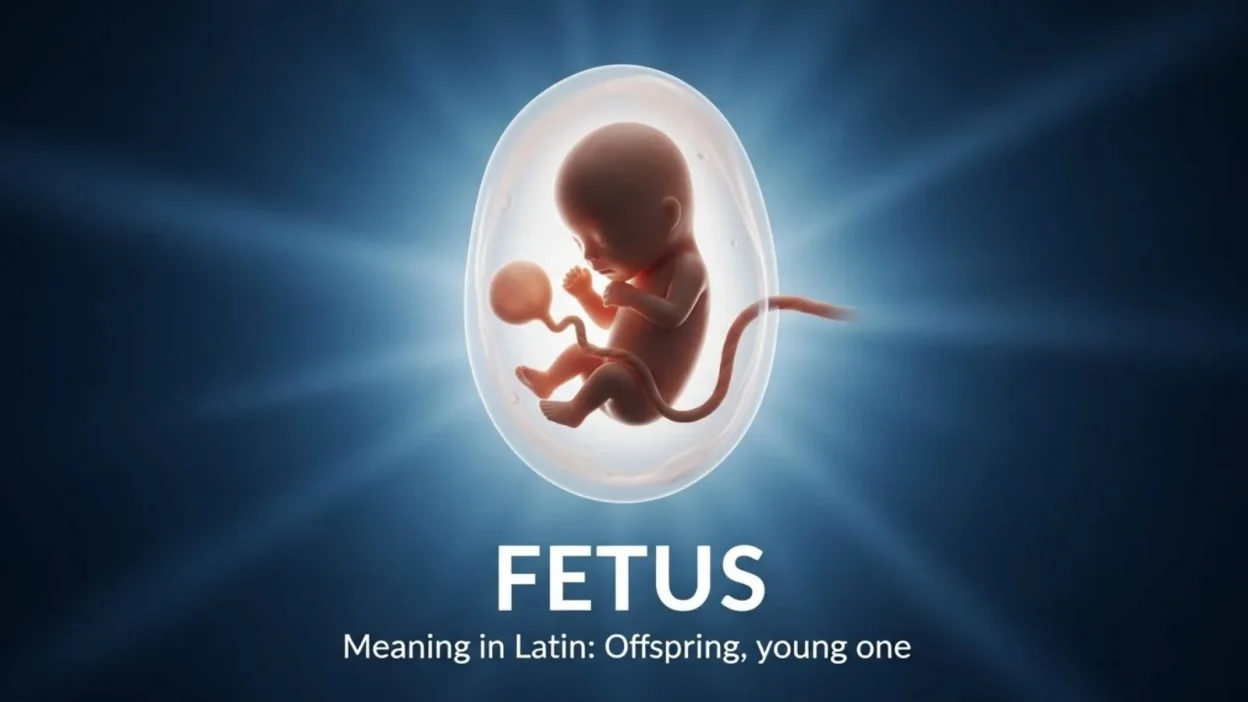
The word “fetus” is widely used in modern medicine, biology, and everyday language, but many people are curious about its origins. Understanding the fetus meaning in Latin offers fascinating insights into how language, science, and history intersect.
In classical Latin, the term fetus literally referred to “offspring,” “bringing forth,” or “bearing young,” emphasizing the process of life and reproduction rather than just a medical stage.
Over time, the word evolved, making its way into English and other European languages, where it took on more precise medical connotations related to prenatal development.
Exploring the Latin meaning of fetus also clarifies common confusions between an embryo and a fetus, as well as how historical texts described childbirth and reproduction.
In this article, we will examine the etymology of fetus, its historical usage in Latin literature, and its significance in modern medicine and language today.
The Etymology of “Fetus”
The word fetus has a rich history rooted in classical Latin. In Latin, fetus primarily meant “offspring,” “bringing forth,” or “bearing young”, reflecting not only the idea of a developing child but also the broader concept of fertility and reproduction. The term is derived from the Latin verb fētāre, which means “to be pregnant” or “to bear young.” This connection highlights that the ancient Romans were deeply aware of the processes of life and reproduction, and language was used to describe these natural phenomena with precision.
Interestingly, in classical Latin texts, the word fetus did not always refer exclusively to what we today call a “fetus” in medical terms. Instead, it could describe any offspring, whether human or animal, emphasizing the act of generating life. Authors such as Celsus and Pliny the Elder used the term in both medical and general contexts, showing its versatility in ancient literature.
Over time, as Latin evolved into the Romance languages and influenced English, the word retained its connection to pregnancy and offspring. In medicine, fetus became a technical term describing the stage of prenatal development after the embryonic phase. Understanding this Latin root of fetus helps clarify both historical references and modern usage, bridging the gap between classical language and contemporary science.
Historical Usage of “Fetus” in Latin Texts
The word fetus has a long history in classical Latin literature, showing how ancient Romans viewed reproduction and prenatal life. In early Roman medical writings, authors like Celsus and Galen used fetus to describe unborn offspring, often without distinguishing between what modern science calls embryos or fetuses. The term was also applied broadly to animals, reflecting the Romans’ observation of gestation in both humans and livestock. This demonstrates that the focus was on the act of bringing forth life rather than a specific developmental stage.
Roman texts also reveal the philosophical and social context of fetus. In legal and ethical discussions, the word appeared in debates about inheritance, personhood, and family lineage, emphasizing its importance beyond medicine. For example, a fetus was recognized as potential life, which affected laws regarding property and family succession.
During the medieval period, Latin remained the language of scholars and physicians, and the term fetus continued to appear in medical manuscripts. Physicians used it to describe stages of pregnancy, fetal movements, and the development of the unborn child. Over time, as Latin influenced emerging European languages, fetus retained its association with offspring and gestation.
Understanding the historical usage of fetus in Latin texts not only clarifies its original meaning but also highlights how medical and cultural perspectives shaped the way societies interpreted life before birth. This historical lens bridges ancient knowledge with modern medical terminology.
Adoption of “Fetus” into Modern Languages
The Latin word fetus gradually made its way into modern European languages, largely through the influence of medical texts and scholarly Latin. During the Renaissance and early modern period, Latin was the lingua franca of science and medicine. Physicians and scholars relied on Latin terminology to communicate ideas clearly across regions, which allowed terms like fetus to become standardized in medical literature.
In English, the term fetus began appearing in medical texts in the 16th and 17th centuries. Initially, it was used more broadly to describe any unborn offspring, maintaining the classical Latin meaning of “offspring” or “bringing forth life.” Over time, however, English and other European languages refined the term’s usage to denote a specific stage of prenatal development—after the embryonic stage but before birth. This distinction remains central to modern medical definitions today.
Other languages influenced by Latin, such as French, Spanish, and Italian, also adopted fetus or its derivatives, often retaining both the literal and medical connotations. For example, French uses fœtus and Italian uses feto, both referring specifically to unborn human development in scientific contexts.
The adoption of fetus into modern languages illustrates the enduring influence of Latin on contemporary science and medicine. Understanding this linguistic evolution helps clarify how historical meanings inform present-day usage and why the term continues to be central in discussions of prenatal development, biology, and healthcare.
Common Misunderstandings About “Fetus”
Despite its widespread use in medicine and everyday language, the word fetus is often misunderstood. One common confusion is between an embryo and a fetus. In modern medical terminology, an embryo refers to the early stages of development, usually from conception to the eighth week of pregnancy, while a fetus is the stage from the ninth week until birth. Many people use the word fetus interchangeably with embryo, but understanding this distinction clarifies prenatal development.
Another misunderstanding arises from the word’s Latin origin. In classical Latin, fetus did not exclusively refer to humans but to offspring in general, including animals. This broader meaning is sometimes overlooked in modern contexts, where fetus is seen strictly as a medical term for human prenatal life.
Some also confuse the term with concepts like fertility or fertilization, likely because of its connection to Latin roots such as fētāre, meaning “to bear young,” and fētilis, meaning “fruitful” or “fertile.” Recognizing these roots helps clarify that fetus specifically describes an offspring in development, not the act of conception itself.
Finally, popular culture and casual usage can blur the term’s precise definition. By understanding both the Latin etymology and the modern medical meaning, these common misunderstandings can be resolved, offering a more accurate and informed perspective on human development before birth.
Related Latin Words and Roots
The Latin word fetus is connected to several related terms and roots that deepen our understanding of its meaning and influence on modern language. One key root is the verb fētāre, which means “to be pregnant” or “to bear young.” This emphasizes the act of generating life rather than a specific stage of development. Another related term is fētilis, meaning “fruitful” or “fertile,” which highlights reproductive capability and abundance. These words illustrate how the Romans viewed reproduction as both a biological and cultural concept.
Other Latin words connected to fetus include generatio, meaning “generation” or “birth,” and proles, meaning “offspring” or “descendants.” These terms often appeared alongside fetus in classical texts, providing context for discussions of family, inheritance, and lineage. The use of these words in combination helped Romans express nuances of reproduction, from conception to the act of bringing forth life.
The influence of these Latin roots extends into modern languages and medical terminology. For example, English words such as fertile, fertility, and even generation are derived from these Latin origins, reflecting the deep linguistic connection between classical language and contemporary concepts of reproduction. Understanding these related Latin words and roots provides insight into both historical and modern interpretations of fetal development, showing how language has preserved these ideas across centuries.
Fetus in Latin Literature Examples
The word fetus appears in numerous classical Latin texts, offering insight into how the Romans viewed reproduction and prenatal development. In medical writings, authors such as Celsus and Pliny the Elder used fetus to describe unborn offspring, often emphasizing the stages of gestation and the potential for life. For example, Celsus discusses fetal development in terms of movement, growth, and formation within the womb, using the word fetus broadly to include both human and animal offspring.
Latin literature outside of medicine also includes references to fetus. Poets and philosophers occasionally used the term metaphorically, connecting it to ideas of creation, potential, and continuity of life. In these contexts, fetus was not just a biological concept but also a symbol of future possibilities and the continuation of family lines.
During the medieval period, Latin manuscripts continued to feature fetus in both medical and scholarly texts. Physicians described fetal positioning, prenatal care, and stages of pregnancy, maintaining the classical Latin understanding while beginning to incorporate observational knowledge. These examples illustrate that fetus was a versatile term in Latin literature, bridging natural observation, medical study, and cultural reflection.
By examining fetus in Latin literature, modern readers can appreciate the word’s historical depth. It highlights how the Romans recognized the complexity of prenatal development and how the term evolved to become central in both medical terminology and literary expression. Understanding these examples helps connect ancient perspectives with contemporary understanding of fetal development.
Significance of Latin Origins in Medicine and Language
Understanding the Latin origin of the word fetus is not only interesting historically but also highly significant in medicine and language today. Latin has long served as the foundation of medical terminology, allowing scholars and physicians across different regions and eras to communicate clearly. Words like fetus provide consistency and precision, reducing misunderstandings in scientific contexts. By tracing fetus back to its Latin roots—fētāre and fētilis—we gain a clearer understanding of what the word originally described: the act of bearing offspring and the potential for life.
In language, the Latin roots of fetus influence numerous modern terms related to reproduction, fertility, and development. Words such as fertility, fertile, and generation all stem from these classical Latin concepts, demonstrating how etymology shapes our understanding of biology and human life. Knowing these roots also enriches comprehension for students, medical professionals, and anyone interested in linguistic history.
Moreover, the Latin origin of fetus helps clarify historical texts, ensuring accurate interpretation of classical literature, medical manuscripts, and philosophical writings. Recognizing that the Romans used fetus in broader contexts—referring to human and animal offspring, potential life, and lineage—adds depth to our modern understanding.
In essence, the significance of the Latin origins of fetus lies in its ability to connect past knowledge with contemporary science and language. It highlights how etymology enhances clarity, precision, and cultural understanding, making it an essential aspect of both medical and linguistic education.
FAQ:
1. What does fetus mean in Latin?
In classical Latin, fetus means “offspring,” “bringing forth,” or “bearing young.” It was used to describe both human and animal offspring and emphasized the process of generating life rather than a specific stage of development.
2. How is fetus different from an embryo?
An embryo refers to the early stage of development, typically from conception to the eighth week of pregnancy. A fetus is the stage from the ninth week until birth. Knowing the Latin origin of fetus helps clarify that it originally referred to offspring in general, not just a human prenatal stage.
3. Where does the word fetus come from?
The word comes from classical Latin, derived from the verb fētāre, meaning “to be pregnant” or “to bear young,” and related to fētilis, meaning “fertile.” These roots influenced its adoption into modern languages and medical terminology.
4. Was fetus used in ancient Roman literature?
Yes. Authors like Celsus and Pliny the Elder used fetus in medical texts, describing unborn offspring, prenatal care, and gestation. Poets and philosophers sometimes used it metaphorically to refer to creation or potential life.
5. Why is understanding the Latin origin important?
Knowing the Latin roots of fetus helps clarify medical definitions, interpret historical texts accurately, and understand the development of related modern terms like fertility and generation.
Conclusion:
The word fetus carries a rich history that spans from classical Latin to modern medicine. In Latin, fetus originally meant “offspring” or “bringing forth life,” and was used broadly to describe human and animal offspring alike.
Over centuries, the term evolved, entering English and other European languages, where it became a precise medical term for the stage of prenatal development after the embryonic phase.
Understanding the Latin origin of fetus not only clarifies its historical usage in literature and medical texts but also explains related modern terms like fertility and generation.
By exploring the etymology, historical context, and adoption into modern language, we gain a deeper appreciation for how ancient knowledge shapes contemporary science and communication.
Recognizing the roots of fetus enhances comprehension in medicine, literature, and linguistics, showing that even a single word can connect history, culture, and science in meaningful ways.

I’m the mind behind Jokesattack.com, your go-to place for daily laughs, clever puns, and hilarious memes. Spreading smiles one joke at a time!