
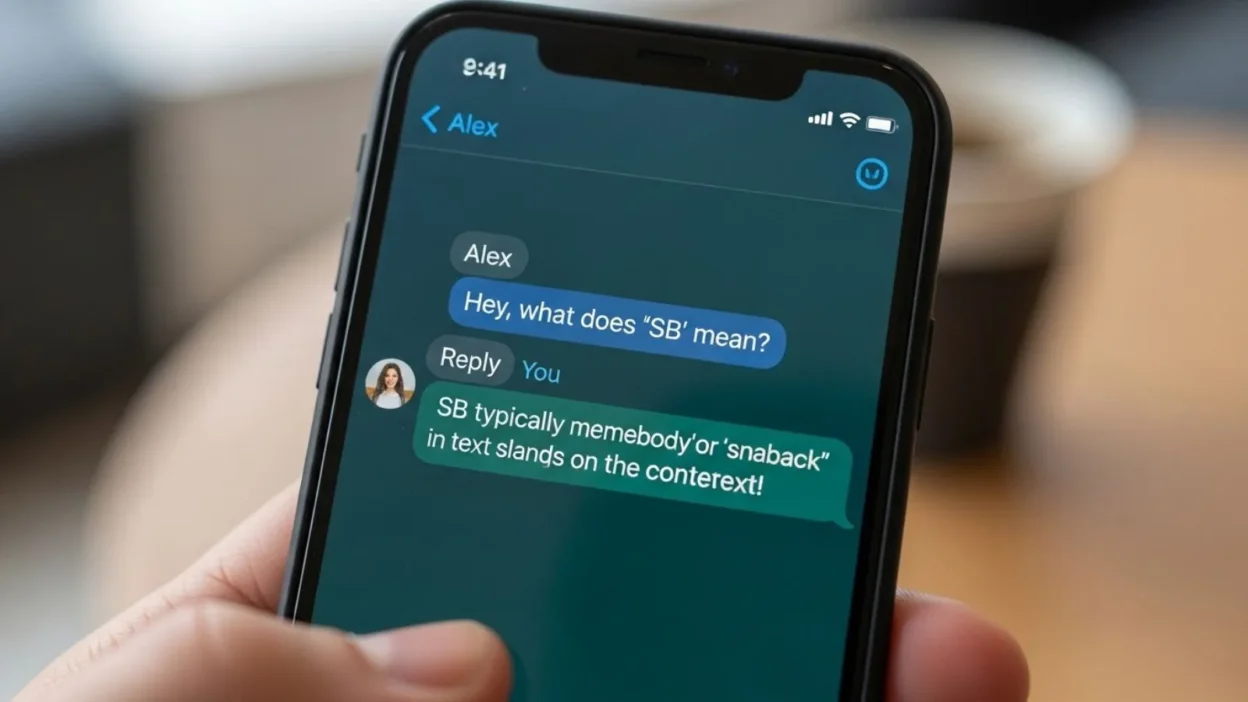
In today’s fast-paced digital world, texting abbreviations and online slang have become a common part of daily communication. One abbreviation that often pops up is “Sb”, and if you’re new to texting culture, it can be confusing.
Understanding what Sb means in text is essential for keeping conversations clear and avoiding misunderstandings. Simply put, Sb is short for “somebody”, and it is widely used in casual chats, social media posts, and messaging apps.
People often use it to save time when typing sentences like “ask sb for help” or “tell sb the news.”
However, Sb can sometimes be confused with other abbreviations like SB, which can mean different things depending on the context.
In this article, we will dive deep into the meaning of Sb, provide examples of how it’s used, explain common misconceptions, and share tips for understanding texting abbreviations so you can communicate confidently online.
What Does Sb Stand for in Texting?
When you see “Sb” in a text or online chat, it might look confusing at first, but its meaning is actually very simple. Sb stands for “somebody” and is a common shorthand used in casual messaging. People use it to save time while typing and to make conversations quicker and easier to read.
For example,
Instead of writing, “Can you ask somebody to help me?”, you might see it written as:
- “Can you ask sb to help me?”
- “Tell sb I’ll be late.”
As you can see, “Sb” replaces the word somebody without changing the meaning of the sentence. It is primarily used in informal texting, social media, group chats, and instant messaging apps.
It’s important to remember that “Sb” is casual and informal. Using it in professional emails or official messages might not be appropriate, as it can seem too casual or unclear.
Another thing to note is that context matters. Sometimes people confuse Sb with SB (capital letters), which can mean other things like Super Bowl or SnapBack, depending on the situation. Therefore, paying attention to the conversation context is key to understanding the meaning.
Overall, Sb is a quick, convenient way to refer to somebody in text messages, and knowing how to use it correctly can make your online conversations smoother and easier to follow.
Origins of Sb in Texting
The abbreviation “Sb” has become a staple in modern texting, but its origins are rooted in the broader trend of shortening words for speed and convenience. As mobile phones, instant messaging apps, and social media became widely used, people began looking for ways to type faster and communicate more efficiently. Long words like “somebody” were often shortened to “sb” to save time and effort while typing on small keyboards or touchscreen devices.
Texting culture, especially among teenagers and young adults, encouraged these shortcuts. Abbreviations like “u” for “you,” “r” for “are,” and “b4” for “before” quickly became part of daily online communication. In this context, Sb naturally emerged as a practical shorthand for “somebody.”
Over time, Sb became widely recognized across various platforms, including WhatsApp, Facebook Messenger, Instagram, Snapchat, and online forums. Its usage is not limited to English-speaking countries either; abbreviations for commonly used words exist in many languages, showing a global trend in online communication.
Despite its simplicity, some people still get confused when seeing Sb for the first time, especially when it appears alongside other abbreviations like SB, which can mean something completely different. Understanding these small shortcuts is essential for reading and sending messages efficiently, avoiding miscommunication, and staying fluent in digital conversations.
How to Use Sb Correctly in Sentences
Using “Sb” correctly in your texts is simple once you understand that it always stands for “somebody.” The key is to place it where you would normally use the full word “somebody” in a sentence. This keeps your message clear while maintaining the informal tone common in texting and social media.
Here are some examples of Sb in sentences:
- “Can sb help me with this assignment?” – asking somebody for assistance
- “Tell sb I’m running late.” – informing somebody about your status
- “Sb left their jacket in the classroom.” – referring to somebody whose identity is known or unknown
- “I need sb to pick me up from the station.” – requesting help from somebody
Notice that Sb is mostly used in informal conversations, whether with friends, family, or peers in group chats. It is not suitable for professional emails, official documents, or formal messaging, because it can appear too casual or unclear.
To use Sb correctly, follow these tips:
- Replace “somebody” with “sb” in casual texts.
- Ensure the context makes it clear who or what “sb” refers to.
- Avoid using Sb in formal or professional messages.
- Pair it with simple verbs like “ask,” “tell,” “help,” or “call” for smooth readability.
By using Sb correctly, your messages become faster to type and easier to read, while still keeping your meaning clear. Mastering this small abbreviation is a step toward becoming fluent in texting shorthand.
Common Contexts Where Sb Appears
The abbreviation “Sb” is widely used across different texting and online communication platforms, but its meaning and appropriateness depend heavily on the context. Knowing where and how it’s used can help you avoid confusion and communicate more effectively.
1. Casual Text Messages:
Sb is most commonly used in everyday texting between friends and family.
For example:
- “Can sb bring snacks to the party?”
- “I told sb about the plan already.”
In these cases, Sb makes the conversation quicker and easier to read without changing the meaning.
2. Social Media Posts and Comments:
Sb often appears in posts or comment sections on platforms like Instagram, Twitter, or Facebook. Users might write:
- “Sb needs to check this out!”
- “I saw sb wearing the same outfit as me.”
Here, Sb is used informally and helps save space, especially on platforms with character limits.
3. Group Chats:
In group messaging apps like WhatsApp, Discord, or Messenger, Sb is frequently used to refer to someone without repeatedly typing their full name:
- “Sb left the meeting early.”
- “Can sb explain the new task?”
4. Gaming or Online Communities:
Gamers and forum users also use Sb for efficiency:
- “Sb join my team?”
- “Sb help me complete this level?”
While Sb is versatile, it’s important to avoid using it in formal communication like work emails or professional messages, where full words maintain clarity and professionalism.
Sb vs Other Similar Abbreviations
While “Sb” is widely recognized as an abbreviation for “somebody,” it’s important to distinguish it from other similar abbreviations, especially SB in capital letters, which can mean entirely different things depending on context. Misunderstanding these abbreviations can lead to confusion in conversations.
1. Sb = Somebody
As we’ve discussed, Sb is always lowercase and used in informal texts to refer to a person.
Examples:
- “Can sb help me with this project?”
- “Tell sb I’ll meet them later.”
2. SB = Super Bowl
In sports contexts, particularly American football, SB often refers to the Super Bowl:
- “Are you watching SB this Sunday?”
3. SB = SnapBack (Social Media)
On platforms like Snapchat, SB can also mean SnapBack, referring to replying to a message or snap:
- “I sent her a SB already.”
4. SB = Scoreboard / Small Business / Other Meanings
Depending on the context, SB may also mean Scoreboard, Small Business, or other industry-specific terms. Always check the context to understand the meaning.
Tips to avoid confusion:
- Look at the context of the conversation. If it’s casual texting, lowercase sb usually means somebody.
- Consider the platform: social media, sports chat, or professional messaging.
- If unsure, ask for clarification to avoid miscommunication.
By understanding the difference between sb and SB, you can confidently read messages without misinterpreting the meaning and maintain smooth communication in all online spaces.
Examples of Sb in Texting Conversations
Seeing “Sb” in real-life texting can help you understand its meaning and usage more clearly. Here are some practical examples of how Sb is commonly used in casual conversations:
- “Can sb help me with my homework?” – asking somebody for assistance
- “Tell sb I’ll be late.” – informing somebody of a delay
- “Sb left their bag in the classroom.” – referring to somebody whose identity may or may not be known
- “I need sb to pick me up from the airport.” – requesting help
- “Sb told me about the event yesterday.” – sharing information someone gave you
- “Can sb explain this new rule?” – asking for clarification
- “Sb forgot to bring the snacks.” – mentioning an absent action
- “I saw sb wearing the same shirt as me.” – describing an observation
- “Sb call me when they’re free.” – requesting someone to make a call
- “Sb left a message for you.” – referring to a previous communication
- “Can sb cover my shift tomorrow?” – asking for help at work
- “Sb needs to finish this task quickly.” – emphasizing urgency
- “Tell sb to check their email.” – directing a message to somebody
- “Sb commented on my post.” – describing online interaction
- “I think sb is waiting outside.” – informing someone of a person’s presence
These examples show how versatile Sb is in informal texting. It saves time, keeps messages concise, and is widely understood in casual communication.
Related Texting Abbreviations to Know
Understanding “Sb” is easier when you also know other common texting abbreviations. These abbreviations make online communication faster and more efficient. Here are some of the most widely used ones:
1. DM – Direct Message
Used on social media platforms like Instagram or Twitter to send private messages.
- Example: “Send me a DM with the details.”
2. FYI – For Your Information
A quick way to share information without requiring a response.
- Example: “FYI, sb left their book in the library.”
3. BRB – Be Right Back
Used to let someone know you’ll return shortly.
- Example: “BRB, sb is at the door.”
4. TTYL – Talk To You Later
Indicates the conversation will continue later.
- Example: “I have to go now, TTYL.”
5. LOL – Laugh Out Loud
Shows amusement in a casual conversation.
- Example: “Sb just made the funniest comment, LOL!”
6. BTW – By The Way
Used to add extra information casually.
- Example: “BTW, sb asked about you.”
7. ASAP – As Soon As Possible
Indicates urgency or priority.
- Example: “Can sb send the report ASAP?”
Learning these abbreviations alongside Sb helps you read and write casual texts more confidently. It also reduces misunderstandings in online chats. Combining Sb with these common acronyms keeps your messages short, clear, and natural, making digital communication faster and more efficient.
Common Misconceptions About Sb
1. Confusing Sb with SB
One of the most common mistakes is mixing up lowercase sb with uppercase SB. While sb always means somebody, SB can have multiple meanings depending on context, such as Super Bowl, SnapBack, or Small Business. Always check the conversation context to understand which meaning applies.
2. Assuming it’s formal language
Some people might think abbreviations like sb are acceptable in professional emails or work communication. However, sb is strictly informal and meant for casual texting, social media messages, or online forums. Using it in formal communication can appear unprofessional.
3. Thinking it’s a recent trend
While texting abbreviations like sb have gained popularity with smartphones and social media, shorthand for words has existed for decades in texting culture, even on older mobile phones with numeric keypads.
4. Misusing Sb in sentences
Another misconception is using Sb incorrectly. For example, saying “Sb’s coming?” is fine in casual conversation, but in formal writing, you should use “somebody” instead.
FAQs About Sb in Texting
Q1: What does Sb mean in chat?
A: Sb stands for “somebody.” It’s used in casual texting, social media posts, and online messages to refer to a person without typing the full word.
Q2: Can Sb mean anything else?
A: In lowercase, Sb almost always means somebody. However, in uppercase (SB), it can have different meanings depending on context, such as Super Bowl or SnapBack. Context is key to understanding the intended meaning.
Q3: Is Sb formal or informal?
A: Sb is informal. It’s suitable for texting friends, family, and social media conversations, but not appropriate for professional emails, academic writing, or formal messages.
Q4: Can Sb be used in professional messaging?
A: Generally, no. Using Sb in work emails or business communication may appear too casual. In these situations, it’s better to use “somebody” in full.
Q5: How do I learn other texting abbreviations?
A: You can learn abbreviations by using online lists of texting acronyms, social media guides, or mobile apps designed for digital communication. Observing casual chats and asking for clarification also helps.
Q6: Are there alternative ways to write Sb?
A: No, Sb is the standard shorthand for somebody in lowercase. Writing it differently may confuse the reader.
Conclusion
Understanding “Sb” is a small but important step toward mastering the language of texting and online communication.
As we’ve learned, Sb stands for “somebody” and is primarily used in informal messages, social media, group chats, and casual online conversations.
Its simplicity helps make messages shorter, faster to type, and easy to understand, but it’s important to use it in the right context to avoid confusion.
We also explored common misconceptions, such as confusing lowercase sb with uppercase SB, and learned that Sb is not suitable for formal communication.
By reviewing examples, related abbreviations, and tips for proper usage, you can now confidently recognize and use Sb in everyday texting.
Staying familiar with common texting acronyms improves your digital literacy, helps you communicate efficiently, and ensures your messages are clear, concise, and correctly interpreted by others.

I’m the author behind Jokesattack.com, where I share the funniest jokes, puns, and memes to make your day brighter with laughter. 😄🎉