
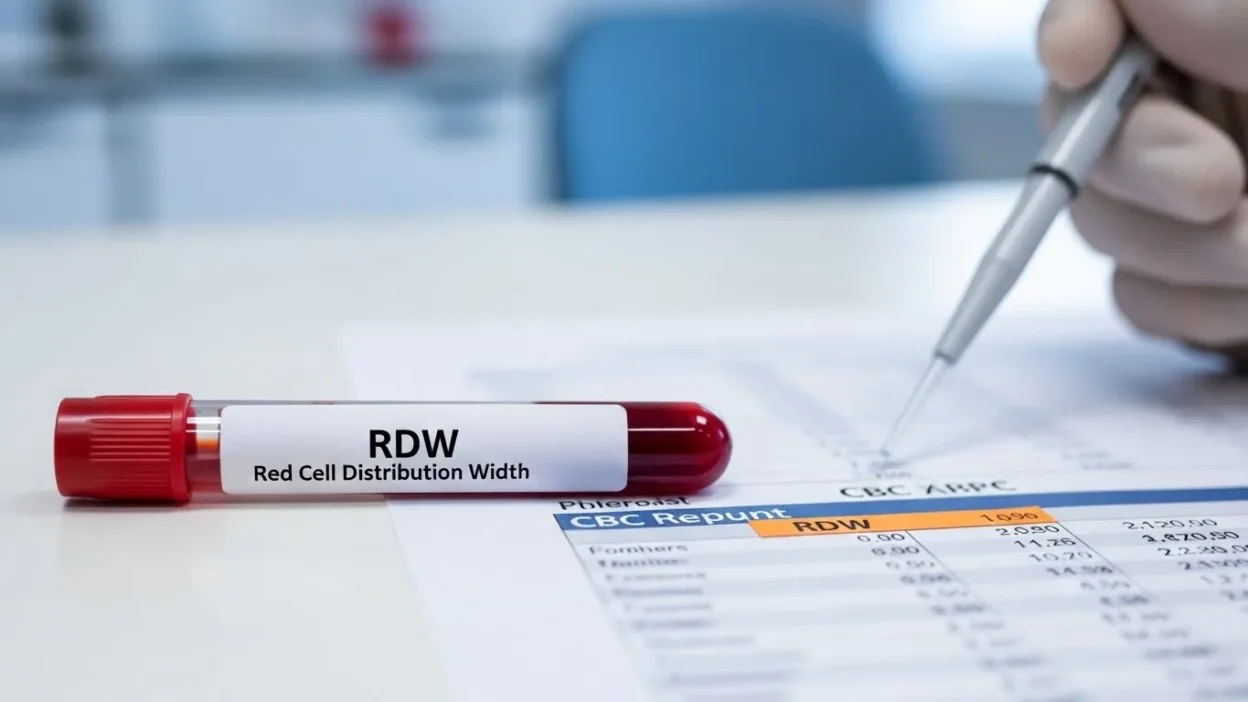
The first time I saw RDW on my blood report, I remember staring at the numbers thinking, “Did my lab just invent a new code?
Is this something serious?” I even zoomed in on the PDF like it would magically explain itself. If you’ve ever felt the same confusion, trust me you’re not alone. RDW looks complicated, but the meaning is actually simple once you understand it.
Quick Answer: RDW in a blood test means Red Cell Distribution Width.
It shows how much variation there is in the size of your red blood cells.
A higher RDW often means there’s a mix of big and small red blood cells which helps doctors understand certain health conditions like anemia.
🧠 What Does RDW Mean in a Blood Test?
RDW stands for Red Cell Distribution Width.
It measures how different your red blood cells are in size. Normally, healthy red blood cells are almost identical in shape and size. But when your RDW is high, it means there’s a bigger variation which can point to issues like vitamin deficiencies, anemia, or other conditions.
Simple Explanation
Think of RDW like checking a box of eggs. If every egg is the same size, great! But if some are tiny and some huge, something is off. RDW works the same way for your red blood cells.
Quick Example
If your report shows RDW high, it means your blood has a mix of different-sized red blood cells.
In short: RDW = Red Cell Distribution Width = Size variation of red blood cells.
📱 Where Is RDW Commonly Used?
RDW isn’t “text slang,” but it is a common medical term used in:
📍 Blood test reports (CBC Complete Blood Count)
📍 Medical summaries
📍 Doctor explanations
You’ll often see it listed along with:
- Hemoglobin (Hb)
- MCV
- RBC count
- MCH & MCHC
Formality level:
➡️ RDW is a formal, medical term, not used in chatting or social media.
💬 Examples of RDW in Conversation
Here are natural, realistic chat-style examples of how someone might mention RDW while discussing a blood test:
1.
A: bro my lab report just came 😭 what’s RDW??
B: it’s about red blood cell size variation. nothing confused.
2.
A: my RDW is high… should i worry?
B: usually it just means anemia or deficiency. doc will guide.
3.
A: my CBC says RDW 16%… is that normal?
B: that’s a bit high. check with your doctor.
4.
A: why do these reports use such confusing terms haha
B: fr 😭 RDW, MCV, MCH… like we’re in science class again
5.
A: doctor said my RDW improved 👍
B: nice! means your treatment’s working
6.
A: my RDW is normal but Hb is low
B: yeah that can happen. depends on the type of anemia
7.
A: how do you even read these blood tests?
B: google + doctor = survival combo 😂
🕓 When to Use and When Not to Use RDW
Even though RDW is a medical term, here’s how and when to refer to it properly:
✅ When to Use RDW
- When discussing your CBC/blood test results
- When asking someone what a high or low RDW means
- When explaining lab findings to friends or family
- When searching for information about anemia
❌ When NOT to Use RDW
- In casual chats unrelated to health
- As a joke or slang term
- When self-diagnosing without professional help
- When giving medical advice without expertise
Comparison Table
| Context | Example Phrase | Why It Works |
| Friend Chat | “my RDW came high 😕 any idea?” | Casual but clear |
| Health Discussion | “RDW helps show size variation in RBCs.” | Informative & simple |
| Work Chat | “I’ll be out today for a CBC (RDW etc.).” | Professional tone |
| Doctor Message | “My RDW was 15%, should I be concerned?” | Clear & appropriate |
| “Attached are my CBC results including RDW.” | Formal & accurate |
🔄 Similar Medical Terms or Alternatives
| Term | Meaning | When to Use |
| MCV | Mean Cell Volume | When discussing average size of red blood cells |
| MCH | Mean Cell Hemoglobin | When checking hemoglobin per red blood cell |
| MCHC | Hemoglobin concentration | When looking at density of hemoglobin |
| RBC Count | Number of red blood cells | When checking quantity of RBCs |
| Hemoglobin (Hb) | Oxygen-carrying protein | When evaluating anemia or fatigue |
| Platelets (PLT) | Blood clotting cells | When checking bleeding issues |
These terms appear together with RDW in most blood test reports.
❓ FAQs:
1. What is a normal RDW range?
Normal RDW is usually 11.5% to 14.5%, depending on the lab.
2. What does a high RDW mean?
It often indicates mixed-size red blood cells, commonly seen in:
- Iron deficiency anemia
- Vitamin B12 deficiency
- Folate deficiency
- Chronic illness
3. What does a low RDW mean?
Low RDW is usually not medically significant and simply means uniform RBC size.
4. Can RDW be high even if hemoglobin is normal?
Yes especially during early anemia or nutritional deficiency.
5. Should I worry about RDW?
Not always. RDW simply helps doctors understand what’s happening in your blood. Only a doctor can interpret it correctly in context.
Conclusion:
RDW in a blood test stands for Red Cell Distribution Width, a key indicator that shows how much variation there is in your red blood cell size.
This value helps doctors diagnose different types of anemia, vitamin deficiencies, and other conditions.
While RDW looks confusing on your report, it’s actually one of the simplest markers to understand once you know that it’s just about cell-size variation.

I’m the mind behind Jokesattack.com, your go-to place for daily laughs, clever puns, and hilarious memes. Spreading smiles one joke at a time!